
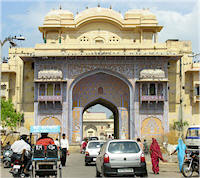
The guided walled city tour takes one to the historical inner city as also the
main shopping centres. The best way is to walk or ride on a cycle or cycle
rickshaw. The old city has a wall around it and at intervals there are gates
with the main ones being Chandpol, Ajmeri and Sanganeri. You will start the tour
from an important intersection called Panch Batti which is roughly within 4
kilometers of most hotels in the city. From this intersection, one also gets a
view of the statue of Maharaja Sawai Jai Singh and adjacent to this is one of
the major cinema halls of the city, Raj Mandir. From M.I. Road, there is a lane
to the north and one enters the walled city through this lane. Once inside, go
towards Khajanae Walon Ka Rasta. Where you can see Jaipur's marble craftmenship
and exquisite marble sculptures, you can purchase one for your collection. The
Khajane Walon Ka Rasta meets another road which is Chandpol Bazar. At the
intersection of Chandpol Bazar and Kishanpol Bazar lies Choti Chaupar where
villagers from around Jaipur come to sell and trade their produce. Kishanpol
Bazar is known for its textiles and tie dye cloth and you can see the artisans
engaged in their work here, producing two forms of the tie- die, bandhani and
loharia. After crosssing Choti chaupar, one enters Tripolia Bazr. Here you see a
number of shops selling domestic kitchen utensils, trinkets, textiles and goods
made of iron. A by lane to the right will take you to Maniharon ka Rasta. Here
you can meet the lac bangle makers and even buy their wares at bargain prices.
To the north of the bazar is the Swargasuli or the Isar Lat (a minaret which
pierces the heaven) and it is the highest structure in Jaipur. The minaret was
got built by Sawai Ishwari Singh as a victory tower. Lacking the Military
accumen and courage of his warriors, Ishwari Singh took his life rather than
confront the advancing Maratha army. His ignominious end was overshadowed by the
sacrifice of his 21 wives and concubines, who performed Jauhar by immolating
themselves upon his funeral pyre.
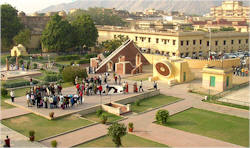
A small distance towards the west from the minaret is Tripolia Gate, a gate with
three arches from which the bazar got its name. This is the main entrance to the
City Palace and Jantar Mantar, but only the Maharaja's family is permitted
entrance via its portals. The public entrance is via Atishpol or Stable Gate, to
the left. You can visit the City Palace complex, the Jantar Mantar and to the
north of the City Palace is the Govindji Temple which has gardens around it. An
image of Lord Govinda was installed here by Jai Singh as a patron deity of his
family. Come out of the complex through the Jalebi Chowk and Sireh Deori Gate.
On your right is the Hawa Mahal. The bazar here is known as the Siredeori
Bazaar, also known as the Hawa Mahal Bazaar. Few yards from here is a large
square known as Bari Chaupar.
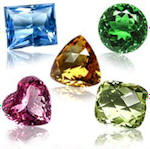 Further
south from the Bari Chaupar is Johari Bazar. Johari bazaar and the small lanes
which dissect it are where you will find Jaipur's jewelers and silversmiths.
There are artisans doing enameling, or meenakari. This highly glazed and
intricate work in shades of ruby, bottle green and royal blue is a speciality of
Jaipur. In Johari Bazzar you can also find cotton merchants interspersed with
the uniform shop fronts are the grand havelis or homes of Jaipur's wealthy
merchants. Look out on your right for the famous Laxmi Misthan Bhandar (LNB) for
namkeens, sweets and paneer ghewar. If you turn right before exiting the
Sanganeri Gate you will reach Bapu Bazaar and farther west, Nehru Bazaar which
extends between Chaura Rasta and Kishanpol Bazaar on the inside of the southern
wall. Brightly colored fabric, shoes of camel skin, trinkets and aromatic
perfumes make this bazaar a favourite destination of Jaipur's women. At the end
of Nehru Bazaar to your left is the Ajmeri Gate. Come out of Ajmeri Gate and the
road is you see is the M.I. Road. Turn right from here and walk down straight
and you are back to Panch Batti crossing - from where you started.
Further
south from the Bari Chaupar is Johari Bazar. Johari bazaar and the small lanes
which dissect it are where you will find Jaipur's jewelers and silversmiths.
There are artisans doing enameling, or meenakari. This highly glazed and
intricate work in shades of ruby, bottle green and royal blue is a speciality of
Jaipur. In Johari Bazzar you can also find cotton merchants interspersed with
the uniform shop fronts are the grand havelis or homes of Jaipur's wealthy
merchants. Look out on your right for the famous Laxmi Misthan Bhandar (LNB) for
namkeens, sweets and paneer ghewar. If you turn right before exiting the
Sanganeri Gate you will reach Bapu Bazaar and farther west, Nehru Bazaar which
extends between Chaura Rasta and Kishanpol Bazaar on the inside of the southern
wall. Brightly colored fabric, shoes of camel skin, trinkets and aromatic
perfumes make this bazaar a favourite destination of Jaipur's women. At the end
of Nehru Bazaar to your left is the Ajmeri Gate. Come out of Ajmeri Gate and the
road is you see is the M.I. Road. Turn right from here and walk down straight
and you are back to Panch Batti crossing - from where you started.


