
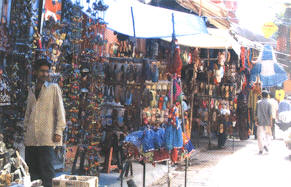
 Although
most tourists visit Jaipur to view its grand monuments, nonetheless there are
many who come to shop. The list of things available is endless, but the more
popular items on the agenda of visitor to the city are jewellery, textiles and
saris, goods made of marble, wood, stone, lac, clay, metal and leather. The city
has been a traditional centre of the finest of jewellery bedecked with both
precious and semi precious stones, enamelling of gold in green, red and white,
the favourite colours of the Mughals, which was introduced Raja Man Singh. The
city is known all over the world for diamond and emerald cutting.
Although
most tourists visit Jaipur to view its grand monuments, nonetheless there are
many who come to shop. The list of things available is endless, but the more
popular items on the agenda of visitor to the city are jewellery, textiles and
saris, goods made of marble, wood, stone, lac, clay, metal and leather. The city
has been a traditional centre of the finest of jewellery bedecked with both
precious and semi precious stones, enamelling of gold in green, red and white,
the favourite colours of the Mughals, which was introduced Raja Man Singh. The
city is known all over the world for diamond and emerald cutting.
Anyone searching for lac jewellery should visit maniharon Ka Rasta where
lac jewellery is made and sold and Johari Bazaar where jewellery is crafted and
sold. The variety is tremendous. Among the buys are table tops, mirror frames,
betel nut boxes and sindoor holders. On the export list are statuettes, photo
frames and pill boxes which are available in abundance on M.I. Road and the
silver shops on the Badi Chaupar crossing. Two lanes joining the main road.
Gopalji ka Rasta and Haldiyon ka Rasta have a number of shops selling jewellery
and on the main road one can see silversmiths. It is closed for some time on
Sunday and Tuesday. The cutting, polishing and selling of precious and semi
precious stones is centred around the Muslim dominated area of Pahar Ganj in the
Surajpol Bazaar area. Silver jewellery is also made there. There are numerous
factories and showrooms along the length of Amber Road between Zorawar Singh
Gate and Holiday Inn. Here one will find hand block prints, blue pottery,
carpets and antiques.
Apart from jewellery, glazed blue pottery, an art that was imported from ground
Persia is very famous. Blue pottery is made from ground quartz stone. On sale
are surahis, pots, ear-rings, soap dishes, door knobs, mugs and jugs. Brass is
another important metal and statures of various sizes are available besides
brass animals used by children as toys. Items made of white metal are also great
buys as are the carvings in stone especially white marble used for making
statues of gods and goddesses, animal and human figures. Carved marble bowls,
vases and other decorative items also figure high on the list of the shopper.
In the leatherware section are the mojaris juttis, bags, saddles, purses, toys
and dolls made of clay and cloth. The city has a large no. of carpet centers and
command a good export market. They are inspired by the Afghan carpets with the
design mostly being Persian and Caucsian, Namads, (Soft Woolen druggets)
decorated and embroidered as also hand - woven cotton durries are speciality of
the city artisans and the main production centre is Tonk. Bapu Bazar and Nehru
Bazar are markets where one can purchase textiles, local perfumes, sarees,
pashmina, shawls and shoes made of camel skin. Bapu Bazar is closed on Sunday.
Textile range from hand - block prints, tie and dye and embroidered fabrics for
which Rajasthan is known worldwide. Sanganer which is on the outskirts of the
city is the prime centre for block - makers and printers with the chief colours
being orange and red with floralprints in yellow and blue - black. They all
combine together to to give an excellent look.
Mirza Ismail Road (M I Road) is a wide and long road where a large no. of
emporia are situated and is the right place for buying a variety of goods
ranging from Jewellery, brass work to textiles. The shops here are a tourists
delight. Since one can buy souveniors, curios, handicrafts and gift items.
During or after shopping it would be worth its while to sample te unusual thick
ice - cold lassi. The emporia and shops accept all credit cards and travelers
cheque. (Closed on Sunday)
Tripolia Bazar and Chura Rasta have textile and utensil shops, trinkets
and all kinds of goods made of iron.
If you are looking for some specific product and want to know where it is
available, refer to the shopping section in the classified information columns.
OTHER SERVICES & SHOPS
Domestic Airlines ~
Airlines & Gsas ~
Jaipur
Train Information ~ Jaipur by Road ~
Jaipur Guide ~
Furniture in Jaipur ~
Forex in Jaipur ~
Handmade Paper Products ~
Jaipur
Handicrafts ~ Jaipur Jewellery ~
Jaipur Pubs Bars ~ Jaipur Sweet
Shop ~ Jaipur Bakeries ~
Jaipur Traditional Bazaars ~
Jaipur Ayurvedic Centres ~
Jaipur Leather Goods ~
Jaipur Furnishing ~
Jaipur Event Organiser ~
Jaipur Dental Clinics ~
Jaipur
Boutiques ~ Jaipur Blue Pottery ~
Jaipur Book Stores ~
Jaipur
Bangles ~ Jaipur Spa ~
Jaipur Textile ~
Jaipur Sarees ~
Jaipur
Silverware ~ Jaipur Potteries ~
Jaipur Musical Instruments ~
Jaipur Opticians ~
Jaipur Marble Statuettes ~
Jaipur Coffee Shop
~ Jaipur Pashmina ~
Jaipur Ambulance ~
Business Jaipur ~
Jaipur Today ~
Jaipur Service Apartments ~ Jaipur Maps
Jaipurtravel.com
A unit of Welcome Rajasthan Tours and Travels,
C/o Umaid Mahal ,C-20 / B-2 Bihari Marg, Jai Singh Highway, Opp. Lane of K.P.
Automotives,
Bani Park, Jaipur - 302016, Rajasthan (India)
Telephone : +91-141-4914416
Mobile Number : +91-9829614748 (06:00 A.M. To 06 P.M.)
Email: info@jaipurtravel.com


