
Forts, palaces, architectural marvels and tales of valour, all in their own way,
bear testimony to the glory that Jaipur is and was just after it was conceived
by Sawai Jai Singh in 1727. Located 262 kilometers from Delhi, jaipur was the
first planned city in northern India. Jaipur's history dates back to the 12th
century when the Kachchwaha clan of Rajputs arrived at the old fort palace of
Amber in the Aravalli Hills. The Kachchwaha belonged to the Kshatriya, or the
warrior caste of Hindus, but they traced their origins back to the sun, via Kusa
who the twin son of the god Rama.
The people the Kachchwahas ousted were the Susawat Minas, who became the
hereditary loyal guards of what became one of the largest and most valuable
treasuries in India. From this base, the Kachchwaha Rajputs, with their
brilliant soldiering, and a knack for lucrative alliances (even if that meant
swallowing Rajput pride), amassed a fortune. It was the special relationship the
Amber rulers developed with the Mughals that brought them real power, influence
and wealth.
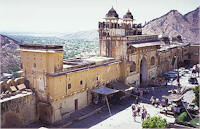 Arriving
from Jaipur through the narrow pass in the hills, you are presented with a view
of the honey colored Amber fort-palace that conforms to every expectation of how
a romantic Rajupt forts should appear. It rambles over a rugged hill, reflected
in Maota Lake below. The odd elephant plods up the ramparts road. In Amber
village, which clusters around the hill, gem-cutters smoothen and cut stones,
the faithful go to mosques and temples, and children run around the royal
chhatris (cenotaphs) and decaying houses. A circle of protective hills surrounds
all this, and snaking up these hills are crenulated walls punctuated by look-our
posts. On the highest ridge and overlooking the valley is Jaigarh Fort, a
spectacular display of defence. Inside Amber Fort, the contrast is sharp, the
grand painted gateway, the hall of public audience that made even the Mughal
emperor jealous, pools and cascades to cool the air in summer heat, and the hall
of mirrors inlaid with tiny pieces of glass so that a single flame creates a
room of thousand bejeweled stars.
Arriving
from Jaipur through the narrow pass in the hills, you are presented with a view
of the honey colored Amber fort-palace that conforms to every expectation of how
a romantic Rajupt forts should appear. It rambles over a rugged hill, reflected
in Maota Lake below. The odd elephant plods up the ramparts road. In Amber
village, which clusters around the hill, gem-cutters smoothen and cut stones,
the faithful go to mosques and temples, and children run around the royal
chhatris (cenotaphs) and decaying houses. A circle of protective hills surrounds
all this, and snaking up these hills are crenulated walls punctuated by look-our
posts. On the highest ridge and overlooking the valley is Jaigarh Fort, a
spectacular display of defence. Inside Amber Fort, the contrast is sharp, the
grand painted gateway, the hall of public audience that made even the Mughal
emperor jealous, pools and cascades to cool the air in summer heat, and the hall
of mirrors inlaid with tiny pieces of glass so that a single flame creates a
room of thousand bejeweled stars.
 The
power to create such a strong fort enclosing such beauty was built up over
several generations. Raja Bihar Mal made the first move. Recognizing Mughal
power, he paid homage to the emperor Humayun and led a 5,000-strong army for
him. Then he made sure he was the first Rajput presented at Akbar's court. His
big chance came when Akbar made his first annual pilgrimage to Ajmer, the burial
place of a Muslim saint, which lay in Kachchwaha territory. On a visit to
Akbar's tent, Bihar Mal gave his daughter to be the emperor's wife and his
adopted grandson, Man Sing, into royal service. The daughter finally gave Akbar
his first son, who became emperor Jahangir. The next ruler, Bhagwan Das,
cemented the alliance and gave a daughter to be Jahangir's wife. Then came the
two rulers who built Amber. Man Singh, a leading general under both Akbar and
Jahangir, and Jai Sing I, a military and diplomatic genius who brought the house
of Amber to its apogee at the Mughal court, On the throne aged 11, Jai Singh I
was soon commanding a Mughal force for Jahangir, then fought all over the Mughal
empire for Shah Jahan and finally backed the right side in the war for
succession and became emperor Aurangezeb's most prized Rajput commander. All
this time, the Kachchwaha coffers were filling with prizes, rewards and booty.
Three rulers later, Jai Singh II, another child prodigy, came to the throne. The
young lad quickly impressed the 71-year-old Aurangzeb who awarded him the title
'Sawai', meaning one-and-a-quarter. Even today, the flag flying above the City
Palace in Jaipur has an extra, quarter sized one next to it. Jai Singh II,
having proved his soldiering ability further enriched his coffers and fulfilled
his other passions - the arts and sciences. The impressive giant stone
instruments which he devised for the open-air observatories at Jaipur, Delhi,
Ujjain and Varanasi stand testimony to his scientific prowess. After ascending
the throne, he shifted the capital from Amer. He studied the architecture of
several European cities and drew up plans for constructing a larger and
well-planned city. He consulted his best mathematicians, astronomers and the
Shilpa Sastra, a traditional Hindu architectural treatise before making the
blueprint for the new city.
The
power to create such a strong fort enclosing such beauty was built up over
several generations. Raja Bihar Mal made the first move. Recognizing Mughal
power, he paid homage to the emperor Humayun and led a 5,000-strong army for
him. Then he made sure he was the first Rajput presented at Akbar's court. His
big chance came when Akbar made his first annual pilgrimage to Ajmer, the burial
place of a Muslim saint, which lay in Kachchwaha territory. On a visit to
Akbar's tent, Bihar Mal gave his daughter to be the emperor's wife and his
adopted grandson, Man Sing, into royal service. The daughter finally gave Akbar
his first son, who became emperor Jahangir. The next ruler, Bhagwan Das,
cemented the alliance and gave a daughter to be Jahangir's wife. Then came the
two rulers who built Amber. Man Singh, a leading general under both Akbar and
Jahangir, and Jai Sing I, a military and diplomatic genius who brought the house
of Amber to its apogee at the Mughal court, On the throne aged 11, Jai Singh I
was soon commanding a Mughal force for Jahangir, then fought all over the Mughal
empire for Shah Jahan and finally backed the right side in the war for
succession and became emperor Aurangezeb's most prized Rajput commander. All
this time, the Kachchwaha coffers were filling with prizes, rewards and booty.
Three rulers later, Jai Singh II, another child prodigy, came to the throne. The
young lad quickly impressed the 71-year-old Aurangzeb who awarded him the title
'Sawai', meaning one-and-a-quarter. Even today, the flag flying above the City
Palace in Jaipur has an extra, quarter sized one next to it. Jai Singh II,
having proved his soldiering ability further enriched his coffers and fulfilled
his other passions - the arts and sciences. The impressive giant stone
instruments which he devised for the open-air observatories at Jaipur, Delhi,
Ujjain and Varanasi stand testimony to his scientific prowess. After ascending
the throne, he shifted the capital from Amer. He studied the architecture of
several European cities and drew up plans for constructing a larger and
well-planned city. He consulted his best mathematicians, astronomers and the
Shilpa Sastra, a traditional Hindu architectural treatise before making the
blueprint for the new city.
After building close bonds with the Mughals and sure that there could be no
danger to his throne, Sawai Jai Singh, envisioned his dream project, the
building of Jaipur. The foundation stone was laid by him in 1727 and an eminent
architect, Vidyadhar Bhattacharaya, was asked to desing the 'Pink City. ' It was
a two-in-one compliment as 'Jai' means victory and was also the ruler's first
name. That it was later chosen as the capital of Rajasthan formed from the
amalgamation of various kingdoms, was a tribute to both Jai Singh and
Bhattacharya.
 The
city was planned in a grid system of seven blocks of buildings with wide
straight avenues lined with trees, with the palace set on the north side.
Surrounding it are high walls pieced with ten gates. The site of the shops were
chosen after careful planning and they are arranged in nine rectangular city
sectors (chokris). Jaipur was the first sizable city in north India to be built
from scratch, though the famous pink colour symbolizing welcome', came later
when Ram Singh II received the Prince of Wales in 1876. The colour was chosen
after several experiments to cut down the intense glare from the reflection of
the blazing rays of the sun. To this day, the buildings are uniformly rose pink.
After Jai Singh died in 1773, a battle for succession followed and the Marathas
and Jats who were making advances in various parts of the country also decided
to try their luck and Jaipur lost large chunks of territory with the ruler
playing second fiddle the fast growing East India Company. In 1818, several
maharajas of the north-west princely states and Maharaja Jagat Singh of Jaipur,
signed a treaty with the British under which they could continue to have control
of their states, but would be collectively supervised by the British under a new
name, Rajputana. After Independence, Jaipur, Jodhpur, Jaisalmer, Bikaner and
other Rajpur states merged to form the state of Rajasthan with Jaipur as the
capital. And even after 273 years after it was founded, jaipur has retained its
unique flavour and old world charm. It is a bustling trading centre with
colorfully set bazars, people sporting blood-red turbans, puppet sellers, and
festivals and fairs.
The
city was planned in a grid system of seven blocks of buildings with wide
straight avenues lined with trees, with the palace set on the north side.
Surrounding it are high walls pieced with ten gates. The site of the shops were
chosen after careful planning and they are arranged in nine rectangular city
sectors (chokris). Jaipur was the first sizable city in north India to be built
from scratch, though the famous pink colour symbolizing welcome', came later
when Ram Singh II received the Prince of Wales in 1876. The colour was chosen
after several experiments to cut down the intense glare from the reflection of
the blazing rays of the sun. To this day, the buildings are uniformly rose pink.
After Jai Singh died in 1773, a battle for succession followed and the Marathas
and Jats who were making advances in various parts of the country also decided
to try their luck and Jaipur lost large chunks of territory with the ruler
playing second fiddle the fast growing East India Company. In 1818, several
maharajas of the north-west princely states and Maharaja Jagat Singh of Jaipur,
signed a treaty with the British under which they could continue to have control
of their states, but would be collectively supervised by the British under a new
name, Rajputana. After Independence, Jaipur, Jodhpur, Jaisalmer, Bikaner and
other Rajpur states merged to form the state of Rajasthan with Jaipur as the
capital. And even after 273 years after it was founded, jaipur has retained its
unique flavour and old world charm. It is a bustling trading centre with
colorfully set bazars, people sporting blood-red turbans, puppet sellers, and
festivals and fairs.
OTHER SERVICES & SHOPS
Domestic Airlines ~
Airlines & Gsas ~
Jaipur
Train Information ~ Jaipur by Road ~
Jaipur Guide ~
Furniture in Jaipur ~
Forex in Jaipur ~
Handmade Paper Products ~
Jaipur
Handicrafts ~ Jaipur Jewellery ~
Jaipur Pubs Bars ~ Jaipur Sweet
Shop ~ Jaipur Bakeries ~
Jaipur Traditional Bazaars ~
Jaipur Ayurvedic Centres ~
Jaipur Leather Goods ~
Jaipur Furnishing ~
Jaipur Event Organiser ~
Jaipur Dental Clinics ~
Jaipur
Boutiques ~ Jaipur Blue Pottery ~
Jaipur Book Stores ~
Jaipur
Bangles ~ Jaipur Spa ~
Jaipur Textile ~
Jaipur Sarees ~
Jaipur
Silverware ~ Jaipur Potteries ~
Jaipur Musical Instruments ~
Jaipur Opticians ~
Jaipur Marble Statuettes ~
Jaipur Coffee Shop
~ Jaipur Pashmina ~
Jaipur Ambulance ~
Business Jaipur ~
Jaipur Today ~
Jaipur Service Apartments ~ Jaipur Maps
Jaipurtravel.com
A unit of Welcome Rajasthan Tours and Travels,
C/o Umaid Mahal ,C-20 / B-2 Bihari Marg, Jai Singh Highway, Opp. Lane of K.P.
Automotives,
Bani Park, Jaipur - 302016, Rajasthan (India)
Telephone : +91-141-4914416
Mobile Number : +91-9829614748 (06:00 A.M. To 06 P.M.)
Email: info@jaipurtravel.com


